Five reasons: an engineered structure is operational in weeks instead of 12–36 months; the price is a fixed manufactured package, not an open-ended construction budget; it installs around a live operation; it can be expanded, reconfigured or relocated as needs change; and it costs a fraction of construction per square metre, keeping capital in the business.
When an organisation needs more space, "build" is the reflex — and for most space problems with a date attached, it is the wrong reflex. Here is the operational case, made properly.
1 — Speed: weeks, not financial years
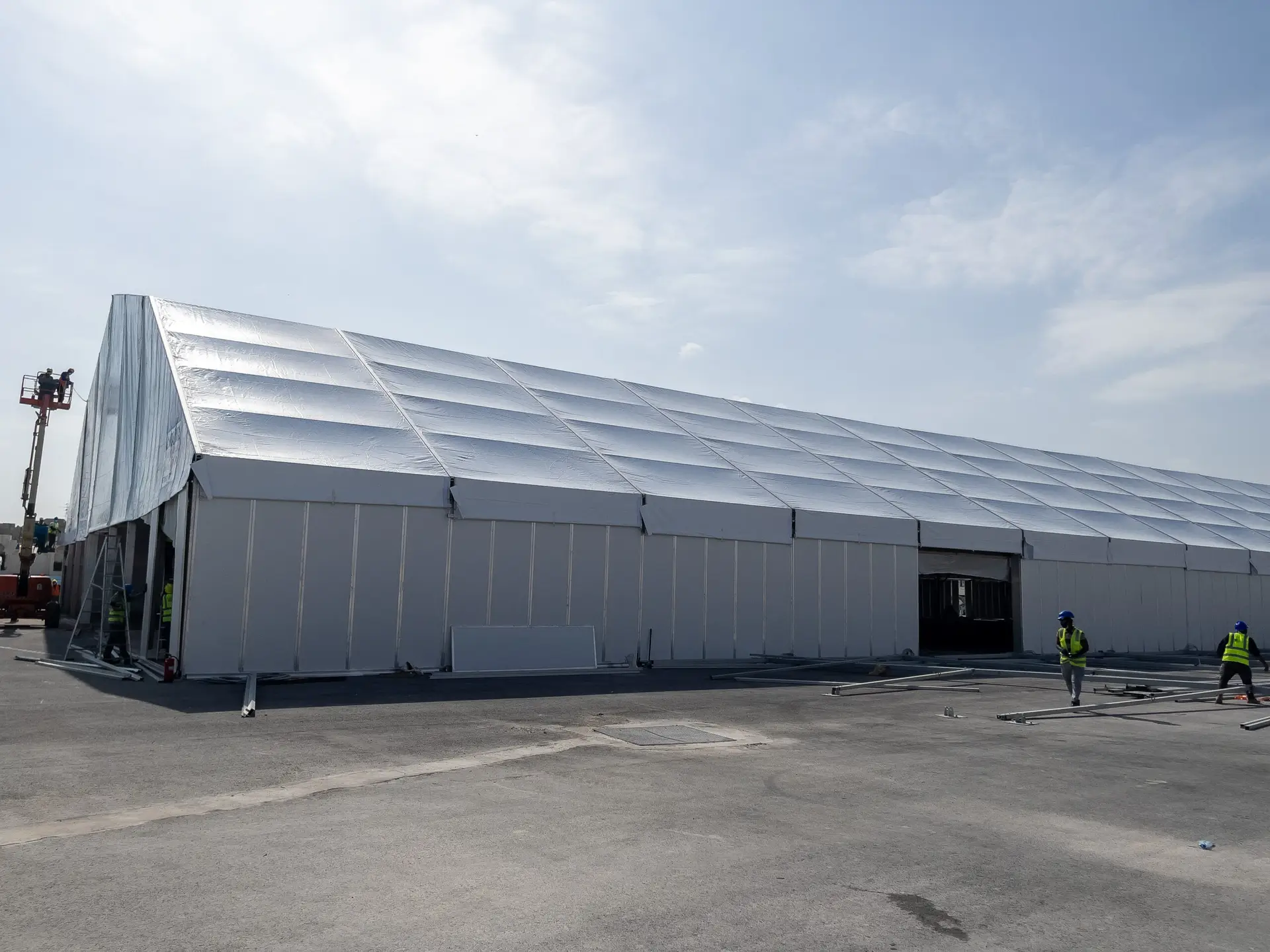
A conventional build runs design, DA, tender, civil works, construction and certification in series — commonly one to three years end to end. A PCS structure is manufactured off site while approvals run, then assembled on prepared ground in weeks (how delivery works). If the need has a date — a contract start, a season, a renovation program — construction has usually lost before pricing is even compared. Speed is also risk control: a shorter delivery window is less exposed to weather, market movements and everything else that erodes multi-year programs.
2 — Cost certainty: a package, not a project
Construction budgets are estimates that meet reality one variation at a time. An engineered structure is a manufactured product with defined components, a fixed scope and a known installation program — quoted as a package and delivered as one. The absolute cost per square metre is a fraction of conventional building; the certainty of that number is worth almost as much as its size.
3 — Continuity: the business keeps running
A construction site inside an operating business is a tax on everything around it — closed zones, noise, safety overlays, months of disruption. Clear-span assembly on prepared hardstand is measured in days-to-weeks of controlled works, sequenced around the operation. Venues stay open through the season; warehouses keep shipping; terminals keep boarding passengers while their replacement goes up beside them.
4 — Flexibility: the only building that follows the plan
Every conventional building is a bet that the future looks like the business case. Semi-permanent structures don't require the bet: modular bays extend when demand grows, reconfigure when the use changes, and the whole building relocates when the master plan moves. For organisations whose honest forecast is "probably, but ask me in two years", that reversibility is the decisive argument — expanded in the three-way comparison.
5 — Capital efficiency: an asset, not an anchor
Capital sunk in construction is capital withdrawn from inventory, equipment and growth — recoverable only by selling the land under it. A purchased structure costs less to begin with, is commonly treated as depreciable plant, holds residual value, and can be redeployed or sold. The same money does more work, and stays liquid enough to follow the business.
Where construction still wins — honestly
Decades of certainty on one site; deep foundations for heavy fixed plant; building classes that can only be met conventionally. If that is your project, build. For everything else — the overflow warehouse, the seasonal venue, the terminal bridge, the classroom block — the engineered structure delivers the same working building in a tenth of the time, at a fraction of the cost, without the bet. Quality is not the trade-off: PCS structures are engineered to AS 1170, council approved, and finished to the standard the use demands (see the range).