
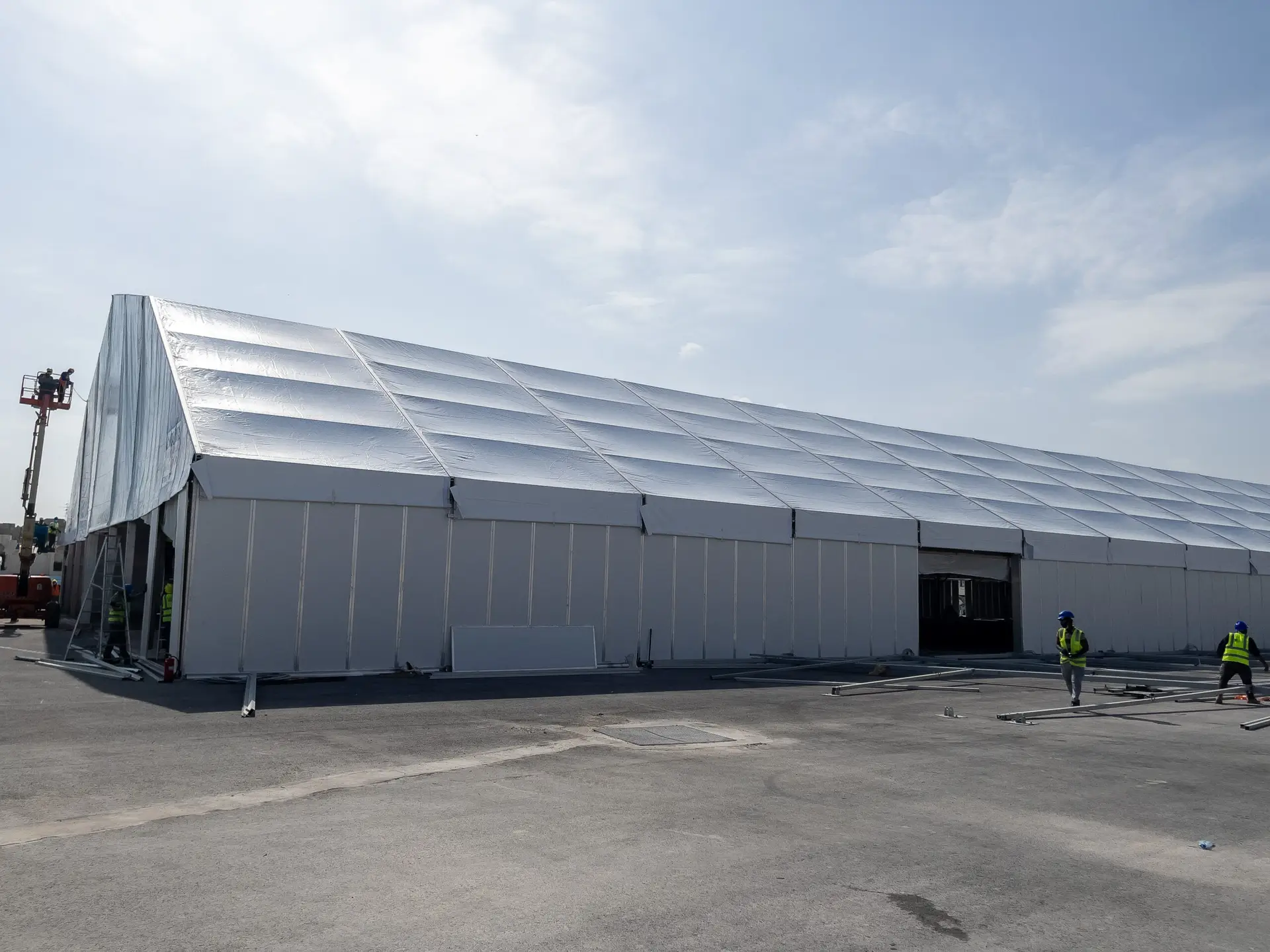
From as little as 48 hours to several months, depending on the path. Smaller structures from assessed used stock can deploy within 48 hours of approval and payment. Standard semi-permanent buildings typically run a few weeks from order to operational. New, custom-engineered European systems can take several months to arrive on site — and are then built quickly, in days to weeks.
Most suppliers answer the speed question with a slogan. The honest answer is that the timeline is a decision you make — and once you understand where the time actually goes, you can choose the path that fits your deadline. PCS supplies both new and quality used marquees precisely so that choice exists.
Indicative timelines by scenario
| Scenario | Indicative timeline | Best for |
|---|---|---|
| Used structure, smaller spans, ready stock | 48 hours from approval & payment | Emergency cover, urgent storage, immediate overflow |
| Used or stock structure, mid-size | Days – 2 weeks | Fast warehousing, seasonal venues, project cover |
| New standard semi-permanent building | A few weeks | Most commercial and industrial projects |
| New custom European-engineered system | Several months to arrive · days–weeks to build | Premium venues, large spans, multi-storey, full fit-out |
| Council approval, where required | Commonly 4–6+ weeks of processing — runs in parallel when started early | Long-term and occupied-use installations |
Indicative only — every timeline is confirmed at scoping, and depends on size, specification, site and freight. The point of the table is the shape: the range is real, and you can choose where on it you sit.
What takes the time — the build, or the lead-up?
The lead-up. On-site assembly is the short part — days to weeks even for large structures, because components arrive manufactured. The timeline is set by manufacture or stock availability, freight, approvals and site preparation — most of which can run in parallel when the project is scoped early.
This is why a new, fully customised European-engineered structure can take months to reach your site and then stand in a fortnight: the manufacturing and shipping dominate, not the build. It is also why used stock is so fast — the manufacturing and shipping already happened.
What happens on site, day by day
For a mid-size clear-span building on prepared hardstand, the on-site build typically runs four to five days: frame assembly and anchoring on day one, roof on day two, walls and doors on day three, and flashings, guttering and services on days four to five. Once frames begin standing, crews typically enclose in the order of 150–250 m² of covered area per day, depending on site and specification.
| Day | Work on site |
|---|---|
| Day 1 | Set-out, frame assembly and anchoring to hardstand — minimal foundation work compared with a conventional build |
| Day 2 | Roof installed — tensioned membrane or insulated roof panels |
| Day 3 | Wall cladding — membrane, insulated panel or glazing — plus personnel and roller doors |
| Days 4–5 | Flashings and guttering, flooring, electrical and climate fit-out, clean-down and handover |
At the small end of the range, the numbers compress dramatically: an event-scale marquee up to roughly 10 × 15 m is raised in hours, not days — typically three to five hours with a four-to-six-person crew on clear, level ground. At the large end, the modular system simply repeats: each additional bay adds frames, roof and walls in the same sequence, which is how large industrial buildings hold a schedule of days-to-weeks rather than months. Weather, ground conditions and fit-out depth (glazing, insulation, services) are the main variables — all identified at scoping, not discovered mid-build.
The fast path: assessed used structures
When the deadline is the specification, a quality used marquee is the fastest covered space money can buy. PCS supplies used structures that have been structurally assessed and documented — frames, connections and membranes checked against the same standards we apply to removals — and smaller structures can be standing on your hardstand within 48 hours of approval and payment. Used stock suits urgent storage, emergency warehousing, disaster response and any project where operational beats optimal.
The custom path: new, European-engineered
When the structure is a long-term asset — a permanent marquee venue, a large clear-span facility, a multi-storey pavilion — the calendar serves the specification instead. New systems are manufactured to your exact span, height, cladding and fit-out; European-made systems, which PCS recommends first, ship to Australia over several months. Once landed, the build itself is quick. For a venue targeting next season, ordering this quarter is what makes the date.
The site-readiness checklist
Most timeline blowouts are site problems discovered late. Confirm these before the crew is booked and the schedule holds:
- Ground. Level hardstand or well-compacted ground is the fast path. Slopes, soft fill and loose gravel are workable but must be flagged at scoping — they change anchoring and may need a sub-floor.
- Anchoring surface. Ground anchors into earth or engineered fixings into concrete; where drilling isn't permitted, ballast systems are used instead and add handling time.
- Clearance. Allow roughly 2 m of clear working space around the full footprint for anchoring and assembly — trees, fences and powerlines all shrink the usable area.
- Access. Components arrive by truck with forklift or telehandler support: delivery vehicles need to work within about 50 m of the footprint, with turning room.
- Underground services. Locate pipes and cables before anchoring — a free Before You Dig Australia enquiry avoids the most expensive kind of surprise.
- Power. Construction power or a generator for the install; the permanent supply sized for the fit-out (lighting, climate control) is confirmed during design.
- Approvals. Where a development application is required, council processing commonly runs 4–6+ weeks — lodge immediately so it runs alongside manufacture; PCS assists throughout.
- Install window. Event season (October–March) books crews solid across the industry. If your date sits in that window, secure the installation slot when you order, not after.
How to compress your timeline
- Consider used or stock structures — the single biggest saving; months become days.
- Build on existing hardstand — no civil works, no curing, no weather exposure.
- Start approvals immediately — where a development application is needed, lodging early lets council time run in parallel with manufacture; PCS assists throughout.
- Scope fit-out with the structure — flooring, power and climate ordered together arrive together.
- Decide once — specification changes mid-manufacture are the most expensive days you can add.